
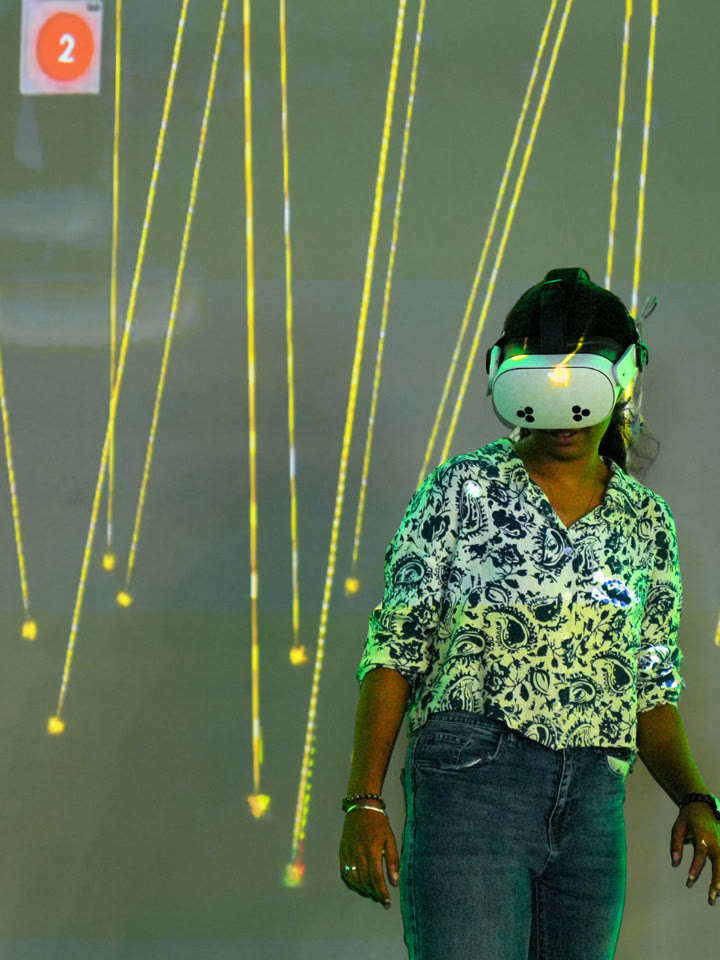
Anyone can throw an imaginary fireball. The interesting question — the one that separates a casual round from a genuine sport — is what happens next. How is the hit registered? Who wins, and why? What's the difference between a team that flails and a team that dominates? This is a look under the hood of the HADO arena: the tech, the scoring and the strategy that make techno-sport tick.
If you've read our intro to HADO, the AR energy-ball sport, you know the headline: it's high-tech dodgeball where you throw virtual energy balls and raise digital shields. But once you step onto the court at Questworld Arena in Marina Mall, you realise there's real depth here — a rule set and a meta that competitive players around the world take very seriously.
The technology that makes it real
HADO runs on two pieces of gear: a lightweight AR headset and a motion sensor strapped to your forearm. The headset overlays the digital layer — energy balls, shields, opponents' life bars — directly onto the real court you can see through it. The arm sensor reads your gestures: a sharp forward flick to throw, an upward motion to shield. Position tracking ties it all together so the system knows where everyone is standing in real space.
The upshot is that nothing is on a screen you tap. The court is real, your teammates are real, and the digital physics play out in the actual air in front of you. That fusion is what earns HADO the "techno-sport" label rather than just "video game."
How scoring works
The rules are simple to state and rich to play. Each player has a set of life points, and each team a shared pool. Here's the core loop:
- Land a hit — when your energy ball connects with an opponent, they lose a life and your team banks the point.
- Block with shields — raise a shield to absorb an incoming ball, but shields have limited capacity and need time to regenerate.
- Survive the clock — rounds are timed (roughly 80 seconds), and the team with more points when the buzzer sounds takes the match.
- Charge management — energy balls need to charge before firing, so you're constantly deciding when to attack and when to hold.
That last point is the secret sauce. You can't spam attacks endlessly; you have to manage your charge, your shields and your positioning all at once. It's a resource game wearing a sport's clothes.
Building your loadout
Before a match, HADO lets you tune your attributes, and this is where personality creeps in. Do you want fast, small energy balls that are hard to dodge but weaker? Big, slow bruisers that punish anyone caught in the open? A beefy shield that lets you play patient defence, or a rapid charge rate for relentless pressure? These trade-offs mean two players can approach the same game in completely opposite ways — the aggressive glass-cannon versus the calm wall — and both can win.
Team tactics that actually win matches
HADO is a 3-on-3 game at heart, and the best teams play like a unit rather than three soloists. A few principles that separate winners from flailers:
- Bait and punish — one player draws a shield out of the enemy, a teammate fires the instant it drops.
- Cover the flanks — spread out so opponents can't line up two of you with a single throw.
- Communicate constantly — call targets and warn of incoming attacks; silence loses rounds.
- Keep moving — a stationary player is a free point. Footwork is defence.
This is why HADO doubles as brilliant team-building and why it fits so naturally into the wider world of physical esports. The coordination it demands is genuine, and it transfers straight back to how a group works together off the court.
Common beginner mistakes (and how to fix them)
Watch any first-time team and you'll spot the same handful of errors. Players stand still, making themselves easy targets. They hoard their shield and never attack, running out the clock without scoring. Or they fire every ball the instant it charges, leaving themselves defenceless for the return. The fix for all three is the same: stay mobile, balance offence with defence, and think one exchange ahead rather than reacting to the last one.
The good news is that improvement is fast and visible. Because rounds are short, a team can play half a dozen matches in a session and feel themselves getting sharper each time — better spacing, cleaner combos, smarter shield timing. That quick feedback loop is deeply satisfying and is a big reason groups keep booking rematches.
Come and read the game for yourself
You can absorb the theory all day, but HADO clicks the moment you feel your first shield hold under fire and land your first clean hit. Questworld's HADO setup is open every day from 10:00 AM to 10:30 PM at Marina Mall, Egattur, on the OMR. The Summer Offer — ₹3,399 for ₹7,200 worth of play plus 120 bonus credits and two free games — gives a team enough runway for a proper set of matches and a wander through the other 25+ attractions. Because it's a scheduled team game, WhatsApp ahead to lock your slot, particularly for tournaments or weekend crowds.
Techno-sport isn't just a gimmick with a good light show — it's a real sport with real depth, and the HADO arena is where you learn to read it. Bring a team that's willing to lose a few rounds before it starts winning them.